What Beverage Flavouring Is
Beverage flavouring is the practice of building and holding a target taste in a drink, from the first sip a consumer takes to the last unit on its shelf life. It sounds close to flavouring any other food, but liquids behave differently and that difference shapes everything a formulator does. In a solid food the flavour compounds are held in a matrix of fat, starch, and protein that slows them down and protects them. In a drink they are dissolved or dispersed in water, which means they are mobile, exposed, and free to react with acids, oxygen, light, and the packaging itself. A flavour that tastes correct on the day it is made can drift, fade, or turn over weeks in the bottle. Beverage flavoring, in the American spelling a developer will see on many supplier datasheets, is as much about stability over time as it is about the initial profile.
Beverage Categories and Their Needs
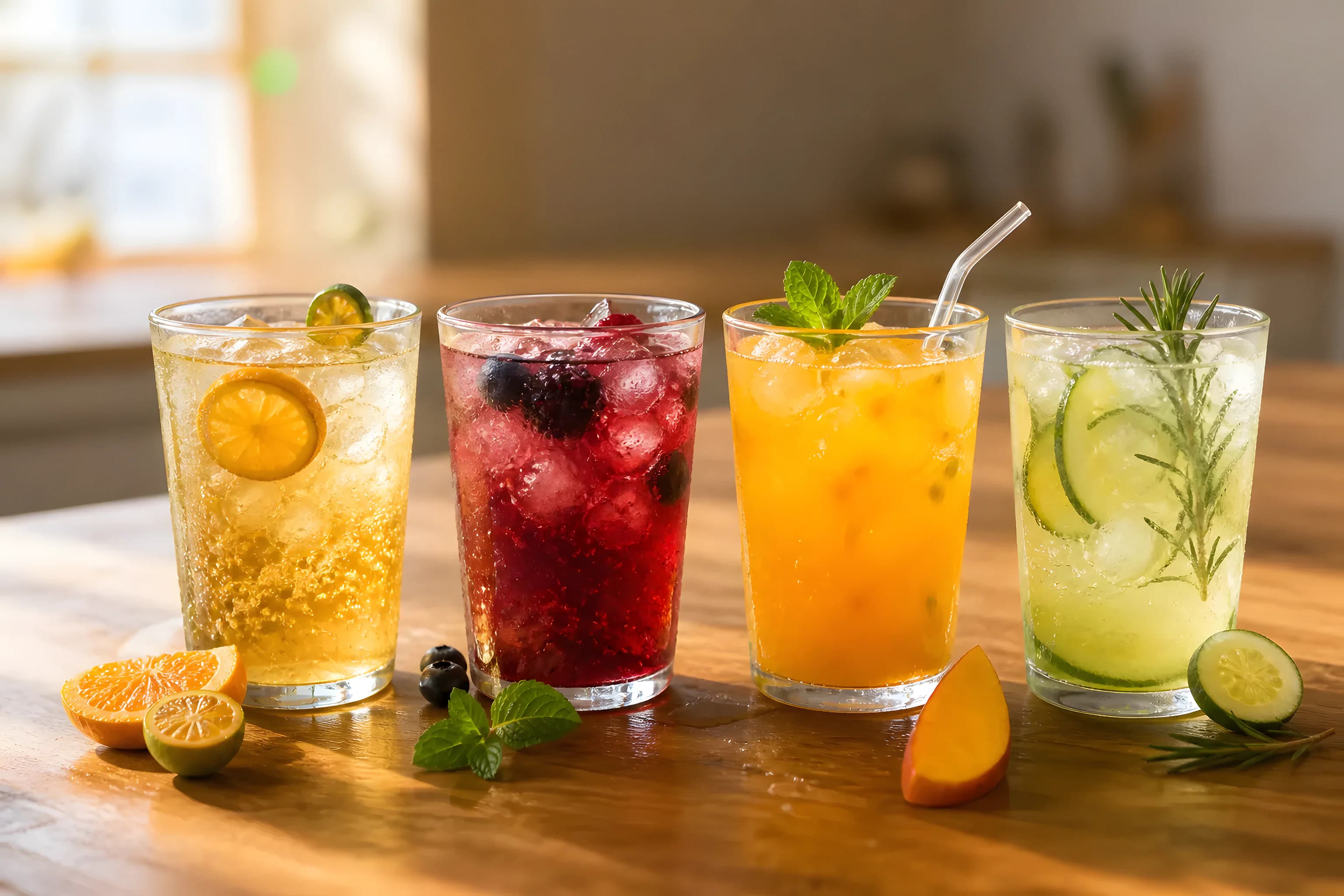
The work also varies sharply by drink category, because each one sets its own taste targets and its own constraints. Carbonated soft drinks need bright, high-impact top notes that carry through carbonation and read instantly, usually over an acidic, sweet base. Juices and nectars carry their own fruit character, so added flavour is there to round, lift, or standardise a profile that shifts with crop and season rather than to build it from nothing. Flavoured waters demand clean, delicate profiles with no off-notes to hide behind, since there is almost no sugar or body to mask a fault. Sports and energy drinks pair flavour with functional ingredients, salts, caffeine, amino acids, and taurine among them, many of which are bitter or saline and need balancing. Ready-to-drink tea and coffee have to keep a true brewed character through heat processing and months of storage. Dairy and plant-based drinks bring fat, protein, and in the plant case a beany or earthy base note that the flavour has to work with. Alcoholic and ready-to-drink cocktails add ethanol, which changes how aroma is released and perceived and which strips some volatile notes faster than water does.
Technical Challenges Unique to Liquids
Several technical challenges are specific to liquids and they are the reason beverage development takes the time it does. The first is flavour stability across shelf life: volatile aroma compounds are gradually lost or transformed, so the profile a consumer meets at the end of shelf life can differ from the one signed off at the bench. The second is pH and acid interaction, since most soft drinks and juices are acidic and many flavour molecules, citral in citrus oils being the textbook case, degrade in a low-pH environment and throw off-notes as they break down; citral cyclises and oxidises into compounds such as p-cymene, p-cresol and p-methylacetophenone that read as stale or medicinal. The third is cloud and emulsion stability: flavour oils do not dissolve in water, so cloudy and citrus drinks rely on emulsions that must not separate, ring, or cream over time. Because the flavour oil is lighter than the sugared water around it (citrus oil sits at about 0.85 against roughly 1.04 grams per cubic centimetre for a sugared soft drink), formulators raise the oil-phase density with a weighting agent such as glycerol ester of wood rosin (ester gum) or sucrose acetate isobutyrate (SAIB) so the droplets neither cream to the top nor ring the neck of the bottle; brominated vegetable oil, once common for this job, has been removed from the permitted list in major markets, with the US FDA revoking its authorisation in 2024, so the choice of weighting agent is itself a compliance decision. The fourth is light and oxygen exposure, a real problem for drinks sold in clear glass or PET, where photo-oxidation and headspace oxygen can fade or stale a flavour; riboflavin can act as a photosensitiser that drives this reaction, and limonene photo-oxidises to off-notes, so UV-blocking PET is a practical mitigation. The fifth is the interaction with high-intensity sweeteners in sugar-reduced drinks, where stevia and similar sweeteners remove the sugar but change sweetness timing and can add a bitter or liquorice-like tail the flavour has to balance. The sixth is heat load: pasteurisation, UHT, and hot-fill all drive off volatile top notes and can cook a fresh profile into a flatter, more processed one, so the flavour has to be designed for the exact thermal process the line will use.
Flavour Formats for Drinks
Because of all this, the format a flavour is supplied in matters as much as the profile itself. Water-soluble liquid flavours are the workhorse for most clear and ready-to-drink applications, dosing cleanly into a water base without clouding it. Emulsions are used where the flavour oil will not dissolve or where a deliberate cloud is wanted, as in many citrus and cream sodas, and they carry both flavour and, often, a cloud or colour component in a stabilised oil-in-water system. Encapsulated powder flavours suit dry-mix and powdered drink formats, instant teas, sachets, and stick packs, where a spray-dried or otherwise encapsulated powder protects the flavour during storage and releases it on reconstitution. The right format is dictated by the product: a sparkling water, a UHT dairy drink, and a powdered energy sachet each need a different delivery system even if the headline flavour, say mango or vanilla, is nominally the same.
Natural vs Synthetic in Beverages
Natural versus synthetic is a live decision in beverages, and it is driven by label, cost, and performance together rather than by any single factor. Natural flavours, defined by where the flavouring substances come from rather than by their chemistry, support a clean-label position that many drink brands now treat as a baseline expectation. They can cost more and can be more variable batch to batch, since they track agricultural supply. Nature-identical and synthetic flavours can offer tighter consistency, lower cost, and sometimes better stability through harsh processing, at the price of the clean-label claim. Many commercial beverages use a considered blend, and the regulatory definition of what may be called natural differs between markets, so the natural-or-not choice is partly a labelling and compliance question for the target country, not only a taste one.
How to Brief a Flavour House
Knowing the categories and the constraints turns directly into a better brief, because a flavour house can only solve the problem it is actually given. Name the drink format and the exact processing it will see, including the fill temperature and whether it is pasteurised, UHT, or hot-filled, since heat load changes what the flavour must survive. State the pH or acid system and the sweetener system, because both move the profile and the stability. Say what the packaging is, clear PET, glass, can, or carton, as light and oxygen exposure differ and the flavourist will design around it. Give the target shelf life, since that sets how much the flavour has to hold rather than simply how it tastes on day one. Share the label constraints, natural or nature-identical, allergen-free, and any halal or kosher requirement for the target markets, and name those markets so sweetness and aromatic direction can be tuned to local preference. The more of the real product a developer can describe, ideally with a sample of the unflavoured base, the faster the iterations converge.
The Grading Systems Your Beverage Will Face
Two grading systems now shape what a beverage compound is allowed to become, and only one of them is law. Singapore's Nutri-Grade bands have applied to prepacked beverages since 30 December 2022 and to freshly prepared beverages since 30 December 2023 and sit in the Sixteenth Schedule to the Food Regulations: not more than 1 g of sugar per 100 ml, above 1 up to 5, above 5 up to 10, and above 10, with a parallel saturated-fat scale, and the poorer of the two grades is the grade. Paragraph 5 then caps an otherwise-perfect drink: a beverage that would grade A on both counts is graded B if it contains any substance “added in place of sugar to provide a sweet taste”. Malaysia has consulted on something similar but has not made it. Draft regulation 18BA, in the Ministry of Health consultation that closed on 4 Julai 2026, proposes A to D sugar bands at the same 1.0, 5.0 and 10.0 g per 100 ml boundaries and the same sweetener demotion. The reason it matters to a flavour house rather than only to a brand owner is its scope: the draft reaches packs that are ready to drink or in powder, concentrate, base or premix form, whether ready to drink or requiring reconstitution, which is the description of a beverage compound. It is a draft. Nothing is gazetted, and the bands are not Malaysian law.
What the Nutri-Grade Evaluation Measured
The published evaluation of Singapore's scheme is also the clearest statement of the problem a beverage flavourist is hired to solve. A before-and-after study in the American Journal of Public Health, on household scanner data from April 2019 to March 2024, reports that “Households reduced sugar purchases by 3.1 grams per day (−18%), and purchases of unhealthy beverages fell 44%”, and that “Reformulation and reassortment lowered sugar content by 1.16 grams per 100 milliliters (−21%) but increased sweetener and lactose use.” The grading worked and it moved the category onto sweeteners, which is why sweetener off-note work is now part of almost every beverage brief in this market.
Natural Colours: Approved Is Not the Same as Available
Colour is the other 2026 story in drinks, and it is a cautionary one rather than an opportunity to act on. In the United States, gardenia (genipin) blue was listed in July 2025, and the order is explicit that the permission is category by category: FDA concluded that its use “at levels consistent with GMP in (1) sport drinks; (2) flavored or enhanced non-carbonated water; (3) fruit drinks and ades; (4) ready-to-drink teas; (5) hard candy; and (6) soft candy is safe.” A petition filed on 4 August 2026 seeks to widen that to sponge cake, alcoholic mixed drinks, carbonated drinks and powdered beverages, but a filing is a docket opening and not an approval. Two other natural colours went backwards: the spirulina extract and beetroot red orders published on 6 February 2026 were both “delayed indefinitely” in March 2026 after objections were filed. None of these colours is permitted in Australia or New Zealand, where nothing of the kind appears on the FSANZ work plan, and none of them is a Singapore permission either. And a like-for-like swap is not what a conversion looks like: Sensient's own 2025 annual report states that “much more natural color is generally needed to replicate the appearance of a synthetic color in an existing product”, which is a dose, cost and lead-time conversation before it is a label one.
Flavour and the Rest of the Formulation
It is also worth being clear about how flavour interacts with the rest of the formulation, because in a drink nothing sits in isolation. Sweetness, acidity, carbonation, and mouthfeel all change how a flavour is perceived, so a profile cannot be finalised against water and then dropped into the finished base unchanged. Reducing the sugar shifts the sweetness curve and exposes notes that the sugar previously rounded off. Raising the acid sharpens some notes and accelerates the degradation of others. Adding a functional ingredient can introduce a bitterness or astringency the flavour then has to cover. The practical consequence is that beverage flavour development works best alongside the base formulation rather than after it, with the flavour evaluated in the real matrix at the real dose through the real process.
How VKA Approaches Beverage Flavour
At VKA we develop flavours for the full range of drink formats, building each profile against the acid system, the sweetener, the thermal process, and the shelf life it actually has to hold, not against a neutral water base. Our beverage solutions cover carbonated and still drinks, juices, flavoured waters, sports and energy formats, ready-to-drink tea and coffee, dairy and plant-based drinks, and alcoholic and ready-to-drink cocktails, in water-soluble, emulsion, and encapsulated-powder formats. The underlying flavour work draws on our Essences Portfolio, and where a profile has to survive heat, light, or a long shelf life we tune the delivery system to match. If you have a drink in development, talk to a flavourist directly and bring a sample of the unflavoured base so the profile can be built in the real product from the start.
Sources
- Perfumer & Flavorist - stability of beverage flavour emulsions
- Reactivity and stability of selected flavour compounds (citral), PMC
- US FDA - revocation of brominated vegetable oil authorisation (2024)
- Singapore Food Regulations, Sixteenth Schedule (Nutri-Grade grading system), paragraphs 2 to 5
- Malaysia, Ministry of Health Food Safety and Quality Programme, online public consultation Bil. 2/2026 (draft regulation 18BA, closed 4 Julai 2026)
- Shin and Tan, Evaluating the Impact of Singapore's Nutri-Grade Beverage Labels, Am. J. Public Health 116(7):893 (2026)
- US Federal Register, 90 FR 31586, Listing of Color Additives Exempt From Certification; Gardenia (Genipin) Blue, 15 July 2025
- US Federal Register, 91 FR 53545, Gardenia Blue Interest Group; Filing of Color Additive Petition, 19 August 2026
- US Federal Register, 91 FR 13966 and 91 FR 13965, Spirulina Extract and Beetroot Red; Delay of Effective Date, 24 March 2026
- FSANZ, Food colours (page last updated 26 November 2025)
- Sensient Technologies Corporation, Form 10-K for the year ended 31 December 2025, Item 1