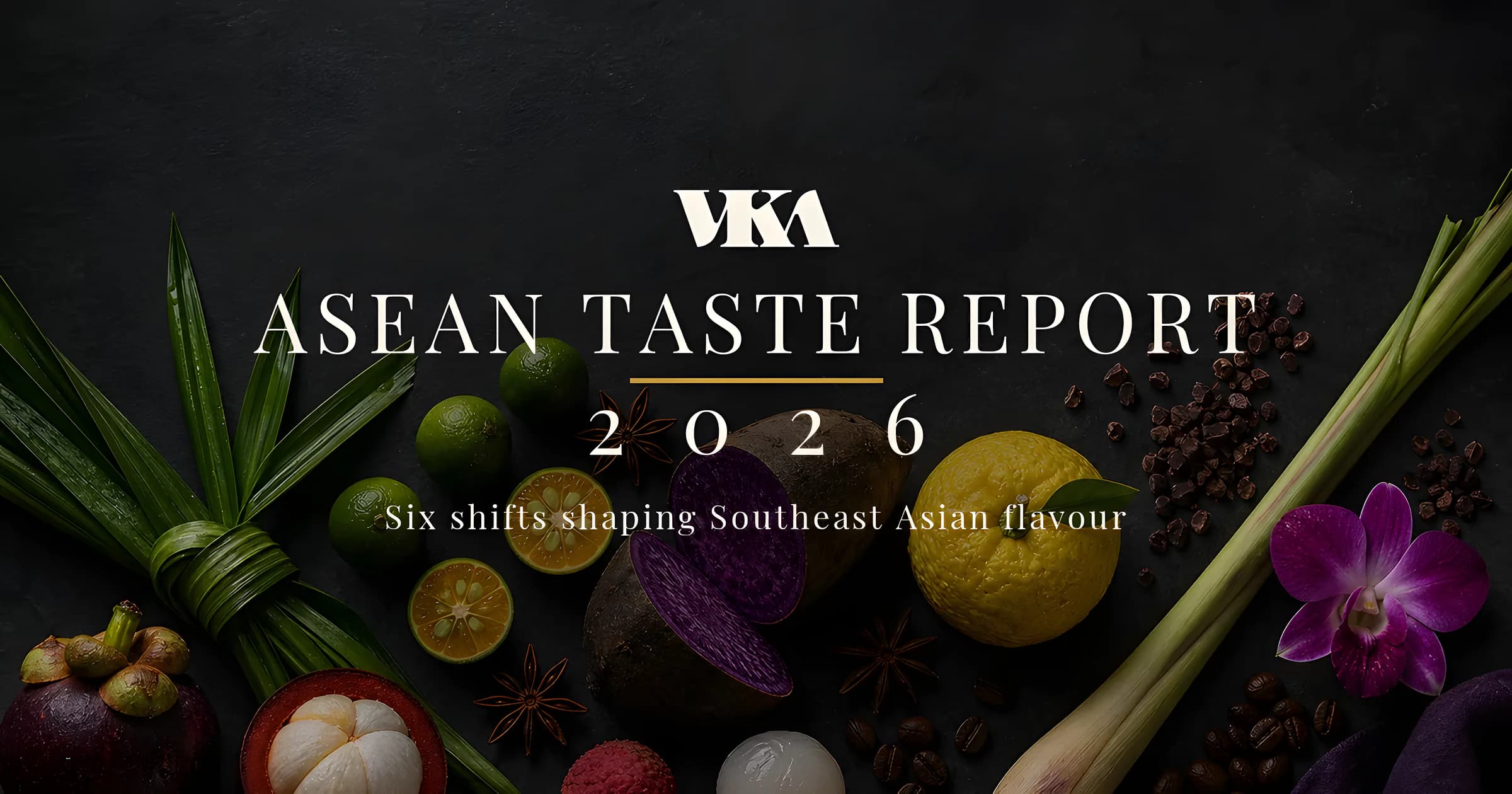
Every flavour house reads the year ahead. VKA reads it from where it has stood since 1971, inside the Asian palate. This is the VKA ASEAN Taste Report 2026: the six shifts we see shaping what food and beverage makers across Southeast Asia will put in front of consumers this year, sorted into what is winning baskets NOW, what is growing fast and NEW, and what is coming NEXT. We have kept it to signals a product team can act on, each tied to published research and to what our own flavourists and application lab see across regional projects.
How This Report Is Built
This outlook synthesises three things: published consumer and market research from named industry sources, regulatory change that is already law or already announced, and VKA's own observation from formulating for Southeast Asian brands.
NOW: Taste and Texture Win the Basket
The clearest signal in the region is that taste and sensory experience, not health claims or price alone, are what close the sale. Cargill's 2025 Southeast Asia indulgence research found that 82% of consumers value a super-sensorial experience, 79% would pay a premium for a distinctive texture, and close to 70% would pay more for a unique taste or an inventive flavour combination, across bakery, chocolate, ice cream and cafe-style drinks. For product teams this reframes the brief: the flavour and the mouthfeel are not finishing touches on a healthier or cheaper product, they are the reason it gets bought again. That is the work an application lab and sensory panel exists to do, and it is why our flavour portfolios are built around character and texture rather than commodity profiles.
NOW: Halal Is the Default, Not the Niche
Halal has moved from a market segment to a baseline expectation across much of the region. Indonesia's regime is now the most expansive in ASEAN: mandatory halal certification has applied to food and beverage products from medium and large domestic businesses since 18 October 2024, Pasal 160(2) of Government Regulation 42 of 2024 runs the phase-in period for micro and small enterprises to 17 October 2026, and BPJPH describes the obligation as applying from 18 October 2026, the day after that period ends. Imported product is a separate question with its own timing: ayat (3) requires the Minister to determine that obligation by 17 October 2026 rather than imposing it, and in early September 2026 BPJPH issued Peraturan BPJPH Nomor 4 Tahun 2026 on conformity assurance for foreign halal product entering Indonesia. Non-halal products must be labelled as such. For a flavour buyer this means halal status is no longer a line to check at the end, it is a constraint that shapes the formula from the first sample, because alcohol carriers and animal-derived inputs are common in conventional flavour systems. VKA is MUIS halal-certified in Singapore and supplies halal flavours into Malaysia, Indonesia and the wider OIC market; we set out how the region's certifying bodies fit together in our guide to halal flavour certification.
NEW: Sugar Down, Pleasure Intact
Reformulation pressure is intensifying and getting more measurable, and the dates are worth getting right. Singapore's Nutri-Grade has graded prepacked beverages on sugar and on saturated fat since 30 December 2022 and freshly prepared beverages since 30 December 2023, and the announced extension to 23 sub-categories of prepacked salt, sauces, seasonings, instant noodles and cooking oils is targeted at mid-2027, with no enabling regulation made as at 13 September 2026. Paragraph 5 of the Sixteenth Schedule is the clause that shapes the brief: a beverage that would grade A on both counts is graded B if it carries any substance added in place of sugar to provide a sweet taste, so a sweetener swap cannot buy an A. The published evaluation of the scheme, on household scanner data from April 2019 to March 2024, found household sugar purchases down 3.1 grams a day and beverage sugar content down 1.16 grams per 100 ml, alongside “increased sweetener and lactose use”. The World Health Organization tightened its guidance on free sugars and on fats in 2023. The brief that follows is not 'remove sugar', it is 'remove sugar and keep the pleasure', because a reduced-sugar product that tastes thin or bitter fails the first trend in this report. That is a flavour and modulation problem as much as a sweetener problem: rebuilding body, masking the off-notes that high-intensity sweeteners bring, and restoring the rounded perception sugar used to provide. It is the work behind our sugar reduction and salt reduction systems.
NEW: Drinks That Do Something
Functional drinks are the fastest-moving beverage story in the region. Innova Market Insights reported on 1 May 2026 that soft drink launches across Asia Pacific grew at a compound annual rate of 16.3 per cent between January 2023 and December 2025. Whatever the market size, the flavour challenge is the same: the actives that make a drink functional, proteins, botanicals, probiotics and minerals, usually taste of something the consumer did not ask for. Making a functional drink palatable is mostly a masking and balancing job, which is why we treat beverage flavour development and flavour masking as one conversation rather than two.
NEXT: Plant-Based Past the Off-Note
Plant-based is maturing from a launch story into a reformulation story, and taste is the hinge. Research for the Good Food Institute across six Southeast Asian markets found something many brands miss: most consumers here are not trying to cut meat, they are after protein diversity, yet more than 80% said they would buy a plant-based alternative priced around 20% below conventional meat, and Mordor Intelligence ranks Asia-Pacific among the fastest-growing regions for meat substitutes. So the regional barrier is value and taste, not conviction: trial does not convert to repeat while pea, soy and chickpea bases carry their beany, bitter and cardboard off-notes. The next phase belongs to makers who fix taste at the protein source rather than spraying flavour over a base that still tastes wrong, building masking and fat-analogue systems into the matrix. We go deeper in our plant-based guide, which draws on the masking and essence work behind our savoury solutions.
NEXT: Heritage Flavours Go Premium
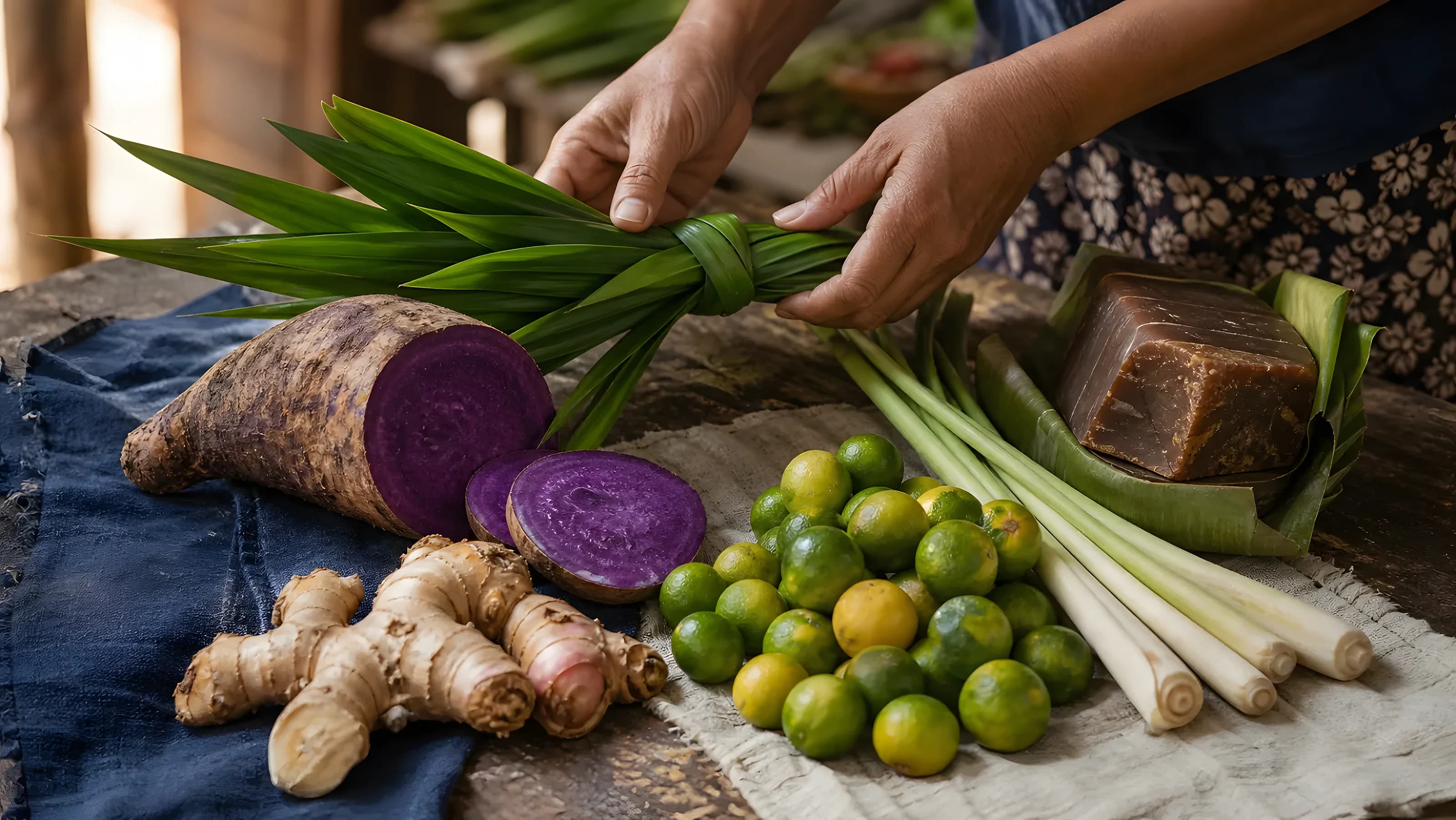
The region's own flavours are crossing from tradition into premium and into export. A 2024 study in Foods shows how thermal processing changes the characteristic pandan aroma in a sponge cake, and a 2024 characterisation of indigenous Durio species from Sarawak in PeerJ relates chemical composition to sensory attributes across species. Pandan, ube and yuzu now appear in premium ice cream, ready-to-drink beverages, craft chocolate and artisan bakery, following the Southeast Asian diaspora into markets far from home. For brands this is the rare trend that is both local and globally legible, but it rewards authenticity: a pandan that reads as green and synthetic, or an ube that is colour without character, fails the super-sensorial test. Getting these profiles right is the half-century of regional palate knowledge VKA was built on, set out in our tropical flavour trends guide and delivered through our essences portfolio.
The Scorecard
The regional scorecard: On sodium, WHO's 2023 global report puts Singapore highest of the ASEAN markets it estimates at 4,508 mg a day, with Thailand 4,250, Indonesia 4,143, Vietnam 4,142, Malaysia 4,134 and the Philippines 4,113, and names Malaysia as the first Western Pacific member state to reach policy score 4. On tax, a 34-year study of 183 countries in The Lancet Global Health puts adoption in “southeast and east Asia” at 47.8 per cent of countries with a median rate of 5.0 per cent, and records that only 5 per cent of the world's sugar-sweetened beverage taxes are sugar-content-based, which is to say that most of them do not pay a manufacturer for reformulating. On ultra-processed food, the largest Asian cohort, the Singapore Chinese Health Study, reports a hazard ratio of 1.06 for all-cause mortality between the highest and lowest quintiles of intake, real but small, with sweetened beverages named among the subgroups driving it. And flavourings are not neutral in that debate: a March 2026 analysis of New Zealand import data classifies flavourings inside the NOVA group 4 inputs whose per-capita import volume has grown faster than any other ultra-processed subgroup since 2011. A buyer who has read that will ask about it.
Turning the Outlook Into a Brief
Read together, the six shifts point one way: in 2026 the winning Southeast Asian product tastes unmistakably good, carries its halal and health credentials without compromising on pleasure, and speaks in a regional flavour voice. That is a harder brief than any single trend, because the constraints pull against each other: less sugar but more pleasure, functional but delicious, authentic but shelf-stable. It is solved in the same place every year, with a precise brief, an application lab that tests in the real product, and a flavourist who has made the regional call before. The trends change; the discipline that turns them into a product that sells does not.
How VKA Reads 2026
VKA® has shaped flavour for the Asian palate since 1971, with flavourists, application technologists and a sensory panel working across our Singapore sites. If one of these shifts maps to a product on your 2026 roadmap, talk to a flavourist directly or browse what our lab does, and bring the brief, because that is where an outlook becomes a launch.
Sources
- Cargill Southeast Asia indulgence research 2025, reported by FoodNavigator-Asia
- State of the Global Islamic Economy Report 2024/25 (DinarStandard), via Salaam Gateway
- Singapore Ministry of Health - Nutri-Grade requirements for sodium and saturated fat
- World Health Organization - updated guidelines on fats and carbohydrates (2023)
- Good Food Institute APAC - plant-based meat market opportunities in Southeast Asia
- Singapore Food Regulations, Sixteenth Schedule (Nutri-Grade grading system), paragraph 5
- Shin and Tan, Evaluating the Impact of Singapore's Nutri-Grade Beverage Labels, Am. J. Public Health 116(7):893 (2026)
- WHO global report on sodium intake reduction (2023), Annex 1 national intake estimates and Table 6
- Moreno Loaeza et al., Understanding sugar-sweetened beverage tax implementation globally, Lancet Glob. Health 14(6) (2026)
- Consumption of ultra-processed foods and risk of mortality: the Singapore Chinese Health Study, Nutrition Journal (29 September 2025)
- Ultra processed foods and their inputs increasingly dominate New Zealand's food and beverage imports, Globalization and Health (12 March 2026)
- Peraturan Pemerintah Nomor 42 Tahun 2024 (Pasal 159, 160)
- Quality-Driven Design of Pandan-Flavored Sponge Cake, Foods 13(19):3074 (2024)
- Characterization of indigenous Durio species from Sarawak, Borneo, PeerJ 12:e17688 (2024)