There is no category shelf life for a flavour, and the industry's own code says so. The IOFI Code of Practice defines it as a method rather than a duration: “The shelf life of flavorings is defined as the period from the date of production during which the flavoring remains suitable for further use.” The number on a specification is therefore the supplier's own determination under their own stated storage conditions, and asking for the stability data behind it is a more useful question than asking how long flavours last.
Re-Testing, Not One Long Date
IOFI ties that period to the label: “This shelf life will be indicated by an appropriate label description that indicates minimum durability under appropriate storage conditions.” The normal industry practice is not a single long date at all, because IOFI also describes re-testing: “Instead of allocating one single extended shelf life, the intention of re-testing is to ensure that the quality is checked at designated intervals and that the optimum quality is maintained during storage and subsequent transportation to the customer, and at the customer's warehouse prior to final use.” The label wording follows from that, and IOFI sets out the options: “Frequency of testing shall be based on the anticipated shelf life of the flavorings and shall be indicated by label descriptions such as 'best before [date]', 're-analyze by [date]', 're-test by [date]', 'expiry [date]' or any other appropriate wording.” If a supplier's drum says re-test by rather than expiry, that is the regime working as designed, not a defect.
Shelf Life Is the Supplier's Determination
Any month figure quoted to you is the supplier's own determination, from the supplier's own data, and it should be traceable to a stability programme.
Why a Flavour Drifts Rather Than Spoils
Flavours also do not usually become unsafe at the end of a shelf life, they stop being the flavour that was approved. Oxidation drives most of it, because the molecules carrying a flavour's character are the ones oxygen attacks: citrus aldehydes, terpenes and unsaturated compounds generally. The practical consequences follow directly. Headspace is reaction feedstock, so a drum opened, partly decanted and resealed for months ages faster than an untouched one, which is why suppliers fill to minimise headspace and why decanting a running drum into smaller packs is good practice. Light adds its own pathway, which is why flavours ship in amber glass, lined steel or opaque drums.
Process Loss Is a Second Clock
Process loss is a second clock and it runs fast. IOFI names it as one of the reasons flavourings exist at all: “The addition of flavorings can be necessary to compensate for the loss of flavor during the processing and storage of foods such as pasteurized foods.” A 2020 study following bread through the oven by proton-transfer-reaction mass spectrometry states the mechanism without putting a general number on it: “Losses of volatile compounds during baking are expected due to their evaporation at the high temperatures of the oven, which can lead to a decrease in the aroma intensity of the final product” It also found that “Interestingly, gluten-free breads presented higher losses of volatiles during baking than wheat bread, which could partially explain their weaker aroma.”, so the matrix is part of the loss, not only the temperature.
A Measured Baking Figure
A 2025 study adding thyme essential oil to bread dough at 50 to 200 parts per million reports that “The recovery of thymol plus carvacrol after baking was 80.0% at 50 ppm, 78.5% at 100 ppm, 76.9% at 150 ppm, and 75.3% at 200 ppm.” Thymol and carvacrol are considerably less volatile than a typical citrus or dairy top note, so 75 to 80 per cent is an optimistic bound rather than a rule for flavours in general.
Water Activity Governs a Powder
For powders the governing variable is water activity, and the failure is a threshold rather than a slope. A 2024 paper in the Journal of Applied Glycoscience defines the critical point: “The critical water content (Wc) and critical water activity (awc) are the water content and water activity (aw) at which the glass transition occurs at 298 K (typical ambient temperature), respectively.” The same paper gives maltodextrin, the wall material most flavour powders are built on, a critical water activity of 0.575, on a table row the paper marks as compiled from earlier work rather than measured in that study. A separate study of freeze-dried maca powder, which fixes the critical water activity as the water activity at which the glass transition temperature reaches 25 degrees, reports that “There was negligible caking below a w = 0.328.” Neither matrix is a flavour powder, so carry the method across rather than the value. The state check does transfer: in a 2025 spray-drying trial, “The moisture content for powders remained uniformly below 5 %, indicating that all were in the glassy state.”, which is the condition a powder has to stay in, and which is the same water-activity story told from the format side in liquid against powder flavours.
What Packaging and Anticaking Change
Packaging and anticaking choice move predicted shelf life materially. In a 2023 accelerated-storage trial in aluminium-laminated pouches, tricalcium-phosphate-treated powder was predicted at 157 days under ambient conditions of 25 degrees and 50 per cent relative humidity and 77 days accelerated at 40 degrees and 90 per cent, against 137 and 39 days for a silicon-dioxide-treated powder. The matrix was spray-dried apricot juice powder rather than a flavour, so the useful finding is the roughly twofold gap between two anticaking choices under accelerated conditions, not the day counts. Under ambient conditions the same trial separates them by about 15 per cent.
The Carrier Is Part of the Protection
The carrier is part of the protection, not just the diluent. The IOFI Code of Practice describes carriers as ingredients used to dilute a concentrated flavouring and disperse it through a food, and notes that some of them also encapsulate it to protect against evaporation and alteration during storage; the definition is quoted in full in our guide to liquid against powder flavours. Encapsulation is therefore a stability decision as much as a handling one, which is why engineered formats are specified for long ambient shelf lives and harsh processes, and why FreshSeal powders and EssenceLock encapsulation exist as separate platforms rather than as packaging options. EFFA states where the carrier ends up: “Carriers may remain in the final product provided they comply with the Regulation (EC) No 1333/2008 on food additives.”
Encapsulation Efficiency Is Not Shelf Life
One 2026 review settles a question that comes up whenever an encapsulated format is proposed as the answer to a shelf-life problem. Writing in the International Journal of Food Science, its authors state that “high encapsulation efficacy is not necessarily enhanced in shelf life, sensory, or physiological efficacy in realistic processing and storage, as well as gastrointestinal processes”. Encapsulation efficiency measures how much flavour went into the capsule. It does not predict how much survives your process or how the product tastes at the end of its life, and the two are routinely quoted as though they were the same number. The practical consequence is the same discipline as the rest of this page: test retention in the finished product rather than accepting a carrier specification.
What the Loading Curve Shows
A loading curve from the same year shows one reason the two diverge. A 2026 study in Foods, building vanillin complexes on soy protein isolate, reports that “The binding efficiency of vanillin decreased from 91.03 wt.% to 69.43 wt.% with increasing vanillin loading”, with vanillin nanocrystals forming above 33.33 wt.% relative to the protein. The study used one carrier in a laboratory model system; the proportion held falls as the load rises.
What the Specification Actually Promises
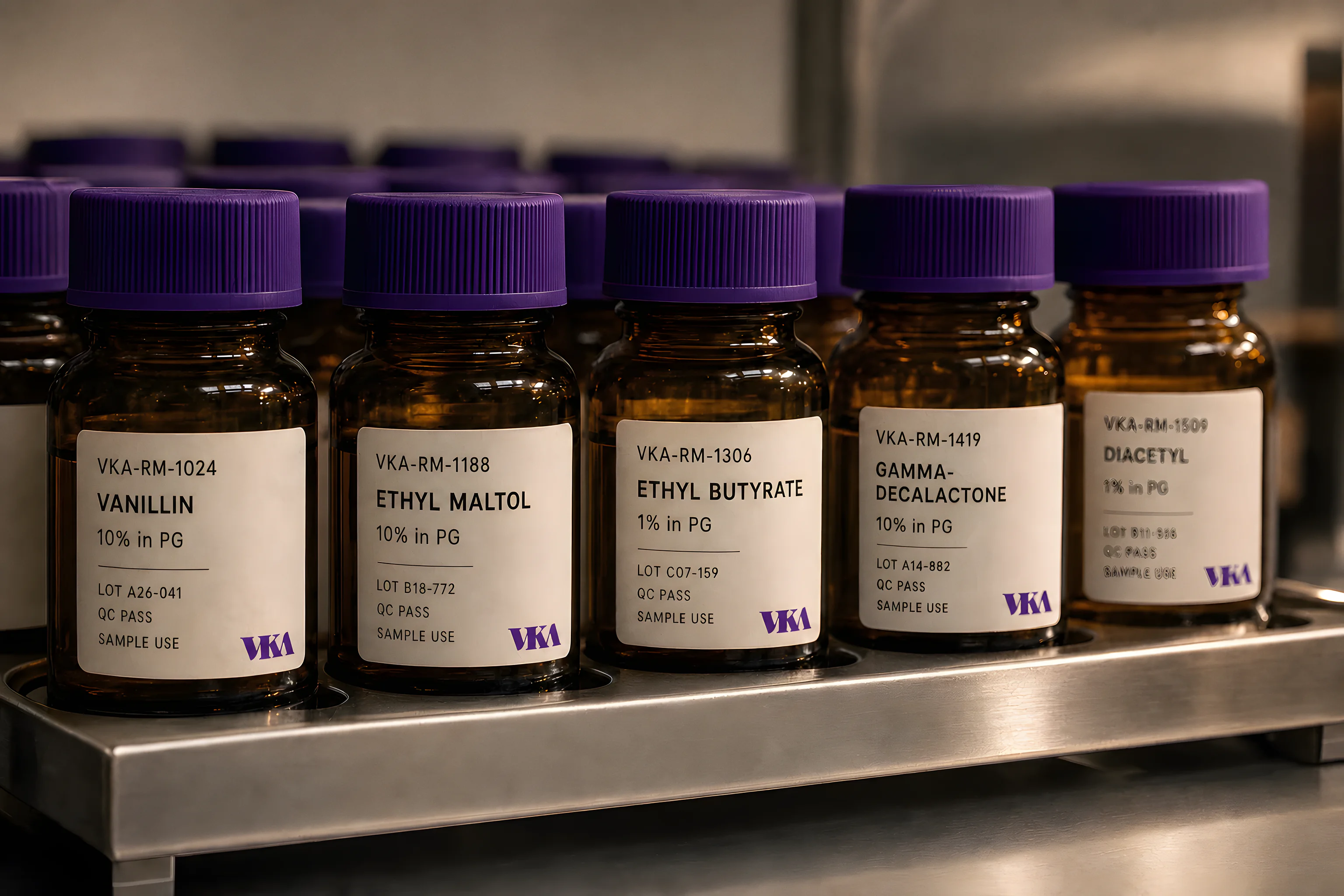
Reading a specification with this in mind, the shelf life line is a promise with conditions attached: stored unopened, in the original container, within the stated temperature range, the flavour will remain within its release specification. It is not a countdown to spoilage and it is not a guarantee against bad handling. Four companion lines matter as much, and each is worth checking every time. Which label wording is used, best before or re-test by, because they imply different regimes. What storage conditions the figure assumes. Whether the supplier holds retained reference samples per batch. And whether a re-test against the reference standard is offered near the date, because an out-of-date flavour is often still within specification and the point of the process is that nobody finds out by tasting the finished product.
Storage and Handling That Protect Flavour
The handling practices that protect a flavour are unglamorous and effective. Store cool, ideally air-conditioned in tropical climates, and never against a hot wall or a sunny dock. Keep containers sealed and decant part-used drums into smaller packs. Rotate stock first-expiry-first-out rather than letting an early batch hide at the back. Keep flavours away from strong-smelling materials, because some packaging breathes and flavours are, by design, concentrated absorbers and emitters of aroma. For powders, hold the storage humidity low enough that the material stays in the glassy state described above, because caking is the point at which the encapsulation stops doing its job. The stability rounds that set these figures in the first place are part of how custom flavour development works.
How VKA Manages Stability
VKA runs the stability side of this in-house in Singapore: accelerated and real-time shelf-life programmes on our own flavours, application-level stability rounds during development, and retained reference samples for every batch released, so a customer question about an ageing drum is answered with data rather than opinion. If a flavour in your store is approaching its date, or a product is drifting in profile across its shelf life, talk to a flavourist directly or browse how our lab works, and bring the batch numbers, because that is where the answer starts.
Sources
- IOFI Code of Practice (5th Revision), sections 5.3.1, 12.1.1 and 12.2, via IOFI General Resources
- EFFA Guidance Documents library (no guidance on shelf life or stability is published)
- Real-time monitoring of volatile compound losses in the oven during baking and toasting of bread doughs, Foods 9(10):1498 (2020)
- Estimation of the antifungal threshold of thyme essential oil for bread preservation, Foods 14(20):3549 (2025)
- Influence of anticaking agents and storage conditions on quality characteristics of spray dried powder, Foods 12(1):171 (2023)
- Browning, starch gelatinization, water sorption, glass transition and caking properties of freeze-dried powders, J. Appl. Glycosci. 67(4):111 (2020)
- Water sorption isotherm and critical water activity of amorphous water-soluble carbohydrates, J. Appl. Glycosci. 71(1):15 (2024)
- Jauhari et al., Encapsulating volatiles by spray drying, Current Research in Food Science 11:101224 (2025)
- Encapsulation in Food Systems, International Journal of Food Science (2026), doi 10.1155/ijfo/7367634
- Dual-Stabilized Vanillin Complexes Based on Soy Protein Isolate, Foods 15(7):1240 (5 April 2026)