The Clause That Caps a Sugar-Free Drink at B
Singapore does not tax sugar in beverages, it grades them, and one clause in that grading decides most reformulation briefs. Paragraph 5 of the Sixteenth Schedule to the Food Regulations provides that “Even though a Nutri-Grade beverage’s sugar content grade and saturated fat content grade is “A”, the grade of the Nutri-Grade beverage is “B” if the Nutri-Grade beverage contains any aspartame, sugar alcohol, carbohydrate alcohol, polyhydric alcohol, or any other substance added in place of sugar to provide a sweet taste.” A sugar-free sweetened drink therefore cannot reach an A in Singapore, whatever the sweetener, and no flavouring can be described as Nutri-Grade A anything, because the scheme grades a finished beverage rather than an ingredient. Elsewhere in the region the pressure is fiscal rather than front-of-pack, and the dates that bite are in 2027 and 2028.
What the Region Actually Taxes, and When
Vietnam and the Philippines set their beverage sugar tax rates in national instruments with dated commencement. Vietnam's Law on Special Consumption Tax 66/2025/QH15 puts soft drinks under the national standard containing more than 5 grams of sugar per 100 ml at 8 per cent from 1 January 2027 and 10 per cent from 1 January 2028, so nothing is payable on that line yet and a reformulation started now still lands ahead of it. The Philippines has not moved since the TRAIN Act: the National Internal Revenue Code section 150-B levies “Six pesos (₱6.00) per liter of volume capacity” on sweetened beverages using caloric or non-caloric sweeteners and “Twelve pesos (₱12.00) per liter” where high-fructose corn syrup is used, with the proviso that “sweetened beverages using purely coconut sap sugar and purely steviol glycosides shall be exempt from this tax”. Malaysia and Thailand also levy excise on sugar-sweetened beverages. Take the current rate for either from the gazetted instrument in force on the day you formulate, since the published summaries lag the gazette.
Singapore's Labelling Approach
Singapore took a different path. Rather than taxing sugar, it implemented the Nutri-Grade labelling system. Products rated Grade D face strict advertising restrictions, effectively stripping brands of their ability to market to consumers through most channels. For beverage manufacturers targeting Singapore, a D-grade rating is a commercial disadvantage that goes well beyond the label itself. It limits shelf placement, promotional opportunities, and brand visibility at the point of sale.
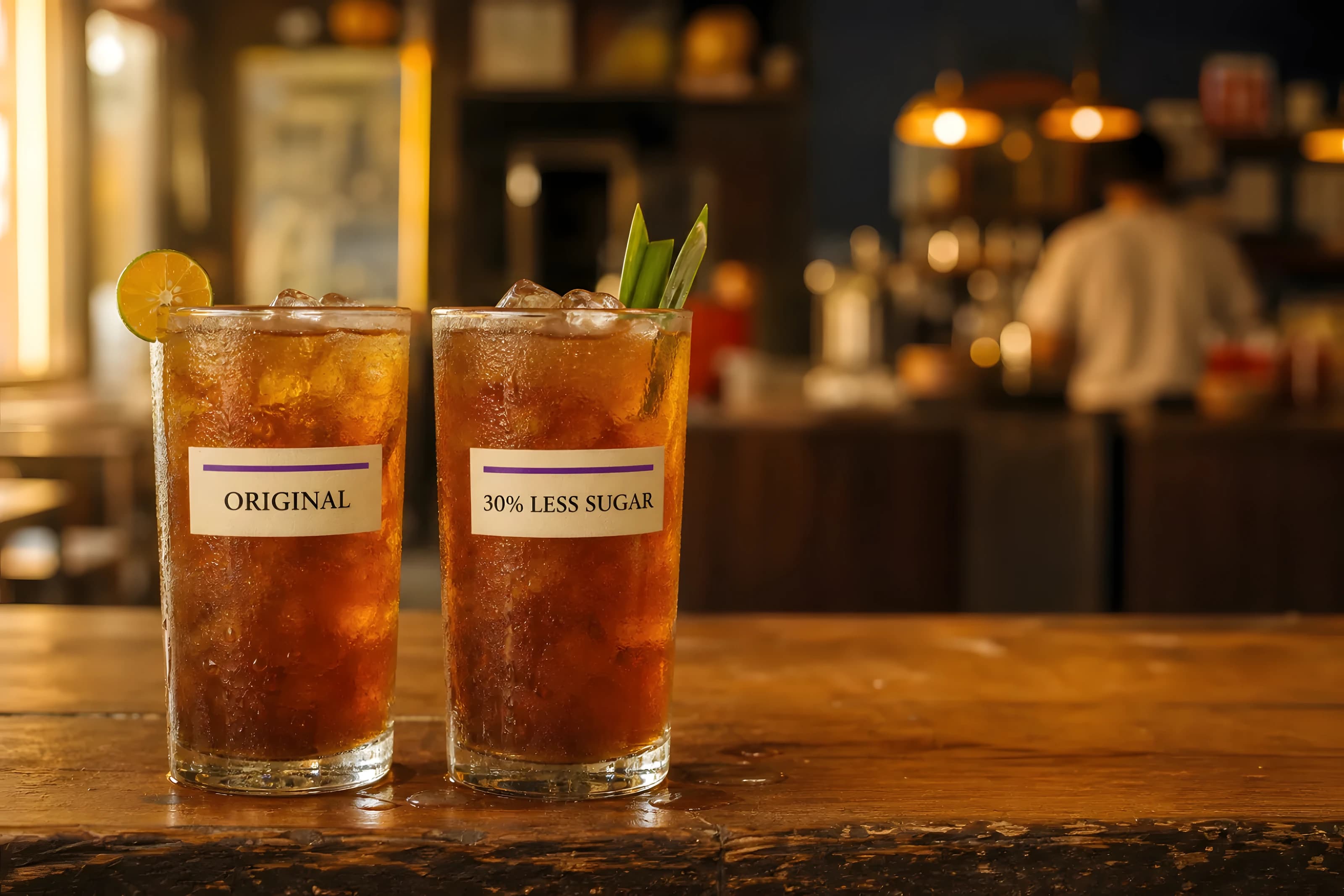
The challenge with sugar reduction is that sugar does far more than sweeten. It contributes to mouthfeel, body, flavour release timing, and preservation. Removing sugar without addressing these dimensions produces products that taste hollow, thin, or leave an unpleasant aftertaste. Consumers notice immediately. Simple sweetener substitution, swapping sugar for a single high-intensity sweetener, rarely works on its own.
Beyond Simple Substitution
Modern reformulation takes a systems approach. Multi-sweetener blends combining two to three different sweeteners, such as stevia (Rebaudioside M), allulose, and small amounts of real sugar, achieve taste profiles that no single sweetener can deliver alone. The glycosides in stevia and monk fruit can be combined to balance each other's off-notes, producing a more neutral, rounded sweetness that more closely resembles sugar's taste curve.
Taste modulation technology adds another layer. Compounds that enhance sweet receptors on the tongue allow manufacturers to use less actual sugar while maintaining perceived sweetness. Flavour pairing strategies also help: vanilla, cinnamon, and certain fruit flavours can amplify sweetness perception without adding any sugar at all. These techniques stack, meaning a product can combine sweetener blending, taste modulation, and flavour pairing to hit aggressive reduction targets.
What the Nutri-Grade Evaluation Measured
There is now a published evaluation of whether front-of-pack grading changes anything, and it carries both halves of the answer. A before-and-after study in the American Journal of Public Health, on household scanner data from April 2019 to March 2024, reports that “Households reduced sugar purchases by 3.1 grams per day (−18%), and purchases of unhealthy beverages fell 44%.” The product side is where a flavourist should read carefully: “Reformulation and reassortment lowered sugar content by 1.16 grams per 100 milliliters (−21%) but increased sweetener and lactose use.” Sugar came out and sweetener went in. That substitution is exactly what produces the bitter tail, the lingering sweetness and the thin body that a masking and modulation brief exists to fix, which is why we treat sugar reduction and flavour masking as one piece of work.
Why Most Sugar Taxes Do Not Reward Reformulation
One design point explains why most regional taxes do not pay a manufacturer to reformulate. A 34-year study of 183 countries in The Lancet Global Health reports that “Taxes were ad valorem (ie, based on price; 45%), volume-based (44%), sugar-content-based (5%), or mixed (6%), and 13% of countries earmarked revenue for public health.” Only the sugar-content-based five per cent reward taking sugar out; a volume or price tax is paid whether the drink is reformulated or not. The same paper puts adoption in “southeast and east Asia” at 47.8 per cent of countries with a median rate of 5.0 per cent, so the tax is the norm and its design is the variable.
What Changed for Sweeteners in 2026
The sweetener toolkit itself moved in 2026, outside Singapore, in ways a customer's technical team will raise. EFSA re-evaluated sucralose (E 955) and found “no need to revise the current ADI of 15 mg/kg bw per day”, but on the proposed extension into fine bakery wares it “could not conclude on the safety of the proposed extension of use”, so sucralose is not cleared for baking. EFSA separately reconfirmed the acceptable daily intake for “aspartame of 40 mg/kg body weight per day”. JECFA, at its 102nd meeting in June 2026, confirmed the steviol glycoside ADI unchanged at 0 to 4 mg/kg body weight expressed as steviol, and gave monk fruit extract only a temporary ADI of 0 to 10 mg/kg body weight as mogroside V, noting that exposure at the proposed maximum levels would exceed it roughly fourfold. Brazzein, a sweet protein, entered the FEMA GRAS list in July 2026 as FEMA 5035. None of these are Singapore instruments. They reach a Singapore formulation through customer specifications and through the JECFA purity default that regulation 15(4) applies where the Food Regulations are silent.
The Australian Contrast
Australia and New Zealand went the other way in the same window, which is worth knowing if you ship both ways. FSANZ closed Proposal P1058 on 23 March 2026, so added sugars will not be declared separately in the Nutrition Information Panel there and total sugars remains the only required sugar declaration. Three sweetener applications are open in that market, A1357 on rebaudioside M and D, A1359 on a honey truffle sweet protein and A1354 on a processing aid for making allulose, but all three sit at administrative assessment and none is an approval.
With health attributes increasingly shaping food purchases across ASEAN, and sugar content among the factors shoppers watch most closely, reformulation is a competitive requirement, not a niche strategy. Brands that reformulate early and well will capture market share as regulations tighten further across the region.
VKA's Sugar Reduction Platform
VKA's Sugar Reduction Technologies are built on flavour science we have refined since 1971. Our approach combines sweetness enhancement, off-note masking, and mouthfeel restoration to help manufacturers meet reduction targets without losing the taste that drives repeat purchase. Learn more at Sugar Reduction Technologies.
Sources
- Royal Malaysian Customs Department, MyExcise: Minuman Bergula (excise duty on sugared beverages, tariff codes 2202 and 2009)
- Excise Department (Thailand), law database record for the ministerial regulation amending the excise tariff for beverages, category 02.02 (mineral and carbonated waters with added sugar or other sweetening matter)
- Singapore Food Regulations, Sixteenth Schedule (Nutri-Grade grading system), paragraph 5
- Singapore Food Regulations, regulation 15(4) (purity of permitted food additives, JECFA default)
- Shin and Tan, Evaluating the Impact of Singapore's Nutri-Grade Beverage Labels, Am. J. Public Health 116(7):893 (2026)
- Moreno Loaeza et al., Understanding sugar-sweetened beverage tax implementation globally, Lancet Glob. Health 14(6) (2026)
- Luat Thue tieu thu dac biet so 66/2025/QH15 (Vietnam Law on Special Consumption Tax), tariff schedule line I.12 and Article 11
- Republic Act No. 10963 (TRAIN), s.47 inserting NIRC s.150-B on sweetened beverages
- EFSA, Re-evaluation of sucralose (E 955) and extension of use in fine bakery wares, EFSA Journal (2026)
- EFSA, Salt of aspartame-acesulfame (E 962) safe at current exposure levels, 10 September 2026
- JECFA, 102nd meeting Summary and Conclusions (9 to 18 June 2026), steviol glycosides and monk fruit extract
- FEMA, Interim GRAS 32 list, July 2026 (brazzein, FEMA 5035)
- FSANZ, Proposal P1058 Nutrition labelling about added sugars, closed 23 March 2026